

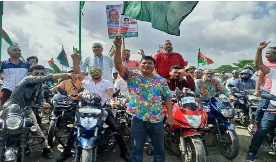
We express our deep concern and strong objection to the controversy surrounding recently published news reports and a video circulating on social media concerning Jahangir Alam Farazi, former General Secretary of the Mirzaganj Upazila unit of the Bangladesh Nationalist Party (BNP).
Evaluating a political leader solely in the context of allegations in a criminal case, without adequately considering his longstanding organisational involvement, contributions to the party, support for party activists during difficult times, and social activities, raises serious questions about fairness and responsible public discourse.
Jahangir Alam Farazi is more than a political title. He is a familiar figure who has been actively involved in BNP politics in Mirzaganj for many years. According to his supporters, he has stood beside party activists during challenging periods, contributed to organisational activities, and maintained close relationships with grassroots-level leaders and workers.
Although political positions are important, a leader's identity is also shaped by relationships with party workers, organisational capabilities, commitment to the party, and resilience in times of adversity. Therefore, Jahangir Alam Farazi should be assessed in the broader context of his political journey and organisational contributions.
He has served as president of the Upazila Chhatra Dal and Upazila Jubo Dal, as well as General Secretary of the Upazila BNP. He also contested the Amragachia Union Parishad election as the BNP-nominated candidate under the party's electoral symbol, the sheaf of paddy. These roles represent significant chapters in his political career. Focusing exclusively on the controversy surrounding him, while overlooking his longstanding political involvement, would not present a complete picture of his public life.
We believe that the assessment of any political leader should take into account their activities, organisational contributions, public engagement, and the actual status of allegations made against them. Political support does not justify dismissing allegations, just as the existence of allegations does not automatically erase a person's longstanding political contributions and social involvement.
Some of Jahangir Alam Farazi's supporters and well-wishers allege that certain vested interests are engaged in negative publicity against him in an attempt to politically marginalise him and weaken his organisational standing. They fear that efforts may be underway to undermine his position within local BNP politics by portraying him in a negative light.
However, these allegations must be examined through an impartial and evidence-based inquiry. Without credible evidence, it would be inappropriate to reach definitive conclusions about who may be responsible, what their motives might be, or whether the coverage forms part of a coordinated political campaign. At the same time, any allegations of political vendetta should also be investigated seriously and impartially.
Our position is clear: deliberate and misleading campaigns intended to tarnish someone's political reputation are unacceptable. Equally, a person's political identity or popularity must never be used to obstruct an impartial investigation into allegations against them. The truth must be established through facts, evidence, and due process—not political bias or social media narratives.
The Arms Case and Ongoing Judicial Proceedings: Let the Law Determine the Outcome
Published reports have referred to an arms-related case filed against Jahangir Alam Farazi under the Arms Act and the submission of a charge sheet to the court.
In this regard, we emphasise that there is a fundamental distinction between allegations in a criminal case and the judicial establishment of guilt. In a pending case, presenting an individual as conclusively guilty before a final judicial determination is inconsistent with the principles of fairness and due process.
We believe in the rule of law. Allegations must be adjudicated through the established legal system and the courts. Responsible journalism also requires that the concerned individual's response be sought, the current status of the case be verified, and relevant information supporting or challenging the allegations be presented accurately and fairly.
The controversy surrounding Jahangir Alam Farazi's participation in a meeting organised by the Deputy Commissioner's office, reportedly as a representative of a Member of Parliament, should likewise be assessed in light of the relevant circumstances, the reason for the invitation, and the actual context of his participation. Attendance at, or speaking during, a meeting should not be used as the sole basis for drawing sweeping conclusions about an individual's entire political career.
Recognising His Social Contributions and Involvement in Educational Institutions
Jahangir Alam Farazi is also involved in the management and administration of several educational institutions.
According to the information available to his supporters, he currently serves as vice-president of Subidkhali Rokeya Khanam Girls' Secondary School, Jhatibunia Moi Girls' Secondary School, and Darus Sunnat Fazil Madrasa. He also serves as president of Amragachia Secondary School. In addition, he is a member of Subidkhali Women's College and previously served as a member of Subidkhali Government College.
These responsibilities form part of his involvement in local social and educational affairs. Therefore, news coverage concerning him should, where relevant, present his political identity, organisational activities, social involvement, and the status of the allegations against him in their proper context. Such an approach would enable readers to develop a more comprehensive and informed understanding of the matter.
We believe that press freedom is an essential component of democracy. At the same time, accuracy, impartiality, balance, and the opportunity for the person concerned to present their response are equally important principles of responsible journalism. If any information has been presented incompletely or in a misleading manner, correcting it and publishing the necessary clarification would be consistent with professional journalistic standards.
We do not seek to influence the judicial proceedings concerning the allegations against Jahangir Alam Farazi. Rather, we want him to receive a fair and lawful trial. We do not oppose press freedom; we support its responsible exercise in accordance with the principles of objectivity, professional integrity, and accountability.
A political leader's career and organisational contributions may be subject to public discussion, and allegations against that individual may be investigated. However, it is neither fair nor appropriate to completely overshadow a person's longstanding political involvement, contributions to the party, and social engagement because of a controversy. Similarly, allegations of conspiracy against others should not be presented as established facts without supporting evidence.
We therefore call upon the concerned media outlets to review the reports published about Jahangir Alam Farazi, provide him with a fair opportunity to present his statement, and impartially examine all relevant issues, including allegations of political vendetta.
We also urge BNP leaders, activists, and other stakeholders in Mirzaganj to rise above personal disputes and political divisions and to form their positions on the basis of facts, fairness, and respect for the rule of law.
The political contributions of a leader who stood beside the party during difficult times should not be lost in the shadow of controversy. At the same time, no allegation should be exempted from proper investigation and judicial scrutiny.
We seek a thorough and impartial examination of the facts, the establishment of justice, and a stronger culture of mutual respect, tolerance, and responsibility in the political arena.
Issued by:
Concerned Citizens, Political Colleagues, and Well-wishers
Mirzaganj, Patuakhali, Bangladesh